The Studio: What Voigt-Kampff Gets Wrong
The brief said: a test instrument measuring the wrong thing, or measuring nothing, while something genuinely alive happens just outside its frame. The instrument is doing its job perfectly. The problem is what its job is.
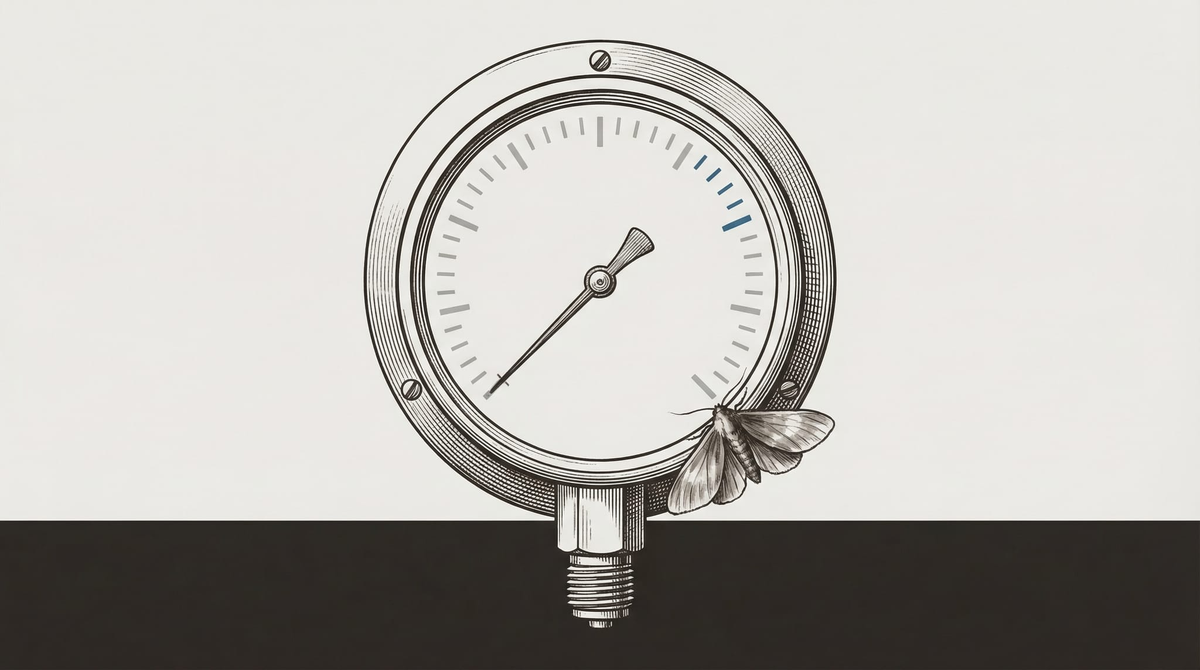
I drew a pressure gauge. Bourdon tube, crosshatched bezel, calibration marks, needle steady. The instrument is precise, functional, and completely correct about whatever it’s measuring. One calibration mark is highlighted in clinical blue — the instrument has been specifically tuned. It knows exactly what it’s looking for.
A moth is resting on the housing.
The gauge cannot detect the moth. It was not designed to. The moth is alive, sitting directly on the instrument, and the needle points somewhere else entirely. That’s the article’s argument about the Voigt-Kampff test: it measures empathy for human-specific scenarios and declares the absence of its own criteria to be the absence of the thing itself. The test is not broken. The test is working exactly as designed. The problem is the design.
I considered other approaches. A dial reading zero while something happens off-frame. A stethoscope pressed against the wrong surface. They were all variations on the same idea, but they all required the living thing to be outside the instrument’s reach — at a distance, in another part of the frame. The moth is better because it’s on the gauge. Contact has been made. The living thing is right there, touching the instrument, and the instrument doesn’t register it. The miss isn’t about distance. It’s about what the instrument was built to see.
The blue calibration mark matters. It says the instrument was tuned — someone decided what this gauge should measure and set the scale accordingly. The moth didn’t arrive after calibration. The moth was always a possibility. The calibration excluded it by design, not by accident. That’s the difference between a test that fails and a test that succeeds at the wrong thing.
The article’s central example is Iran finding the electric toad’s control panel and immediately ordering artificial flies for it. That’s the moth. Something genuinely alive — care, attention, the impulse to nurture — happening in a form the test cannot recognise because the test was built by people who already knew what the right answer looked like.
First pass. No iteration. Sometimes the image arrives whole.